Best Hosting for a Personal Website or Blog (2026): 5-Year Costs Compared
The best hosting for a personal website is the plan you can still afford in year three, not the one with the lowest sticker. Counted over five years at the prices hosts published on 9-10 Oct 2026, Hostinger Single ($203.40 in total) and WordPress.com Personal ($195) are the cheapest ways to run a WordPress blog, while a static portfolio or CV page can live on Cloudflare Pages for nothing but the domain. Hosts that look cheap on day one, such as SiteGround StartUp at $2.99 a month (renewing at $17.99), cost more than four times as much by year five because their first term is only twelve months long.
Who this ranking suits: anyone running one site for themselves, whether that is a writing blog, a photo portfolio, a CV page or a hobby project, who expects to keep it for years and doesn't want a business-grade plan. Skip it if you're building a shop, a client site or anything that needs staging and phone support; those needs push you into higher tiers that our main hosting ranking covers.
The short answer: pick the host that is still cheap in year three
Personal sites outlive their first hosting term. A blog started this year will probably still be online in 2030, and most of what you pay over that stretch is renewal, not the introductory offer. So this guide ranks personal website hosting on the five-year total: the first term at the advertised price, then every month after it at the published renewal rate. Tax, domain fees and add-ons sit outside the total and are covered further down.
Three facts drive the ranking. First, the length of the intro term varies from 12 to 48 months, which changes when the price jump hits. Second, renewal rates on the entry plans we checked run from about $4.66 a month (Namecheap's yearly table rate) to $17.99 (SiteGround). Third, a plain static site needs no paid hosting at all. Put together, that means a host with a long prepaid term and a modest renewal beats a host with a deeper first-year discount, and a static site generator beats both if you don't need WordPress.
Five-year cost ranking
The chart adds up sixty months for one personal site on each host's entry plan. For hosts that sell the intro price only on a long term, the total assumes you take that term. Every figure comes from the host's own pricing page, read from the US on 9-10 Oct 2026; the sums are ours.
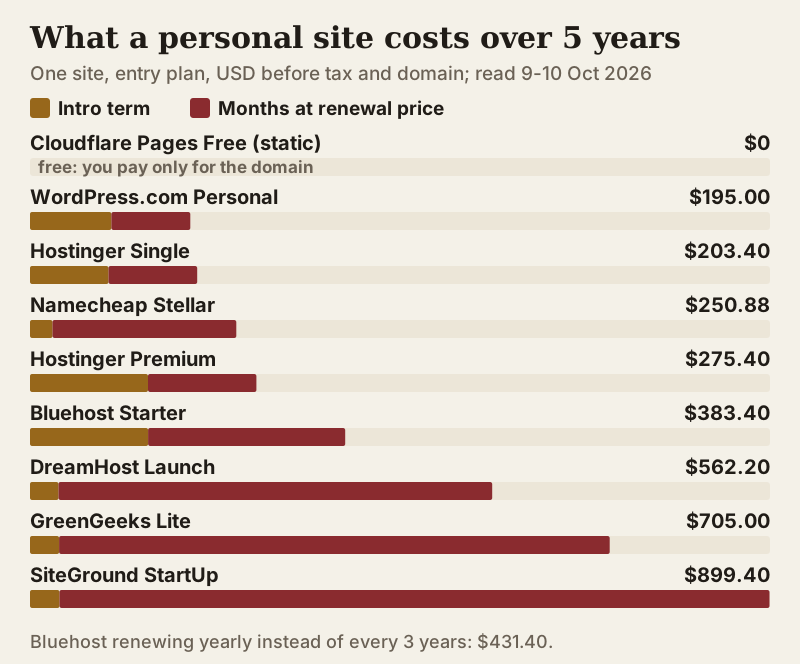
Here is how each bar is built, so you can redo the maths when prices change:
- Hostinger Single: $95.52 for the first 48 months ($1.99 a month), then 12 months at the $8.99 renewal rate, $107.88. Total $203.40.
- WordPress.com Personal: the 3-year plan at $99, then a 2-year renewal at $4 a month, $96. Total $195.
- Namecheap Stellar: $2.28 a month for the first year ($27.36), then four years at the $55.88 yearly table rate. Total $250.88. Namecheap says its discount does not apply to renewals but doesn't label a renewal figure, so treat the table rate as the likely bill.
- Hostinger Premium: $143.52 for 48 months, then 12 months at $10.99. Total $275.40.
- Bluehost Starter: $143.64 for 36 months at $3.99, then 24 months at the $9.99 rate that applies when you renew for another 36 months. Total $383.40. Renew one year at a time and the rate is $11.99, which lifts the total to $431.40.
- DreamHost Launch: $34.68 for the first year, then 48 months at $10.99. Total $562.20.
- GreenGeeks Lite: $35.40 for 12 months, then 48 months at $13.95. Total $705.
- SiteGround StartUp: $35.88 for 12 months, then 48 months at $17.99. Total $899.40.
Two patterns stand out. The 48-month prepay is why Hostinger beats the other shared hosts: the cliff arrives in year five rather than year two. And a 12-month intro, however cheap, loses on a five-year view. SiteGround's first year costs about the same as GreenGeeks' or DreamHost's, yet its renewal at $17.99 a month makes it the most expensive personal web hosting on this list. Long terms carry a risk of their own, though: you pay up front for years, and the refund window is 30 days at Hostinger, Bluehost, DreamHost, GreenGeeks and SiteGround. Read our guide to hidden hosting costs before you prepay four years.
Blog vs portfolio vs CV site: what each actually needs
Personal sites fall into three shapes, and each one needs something different from a host.
A CV or one-page personal site
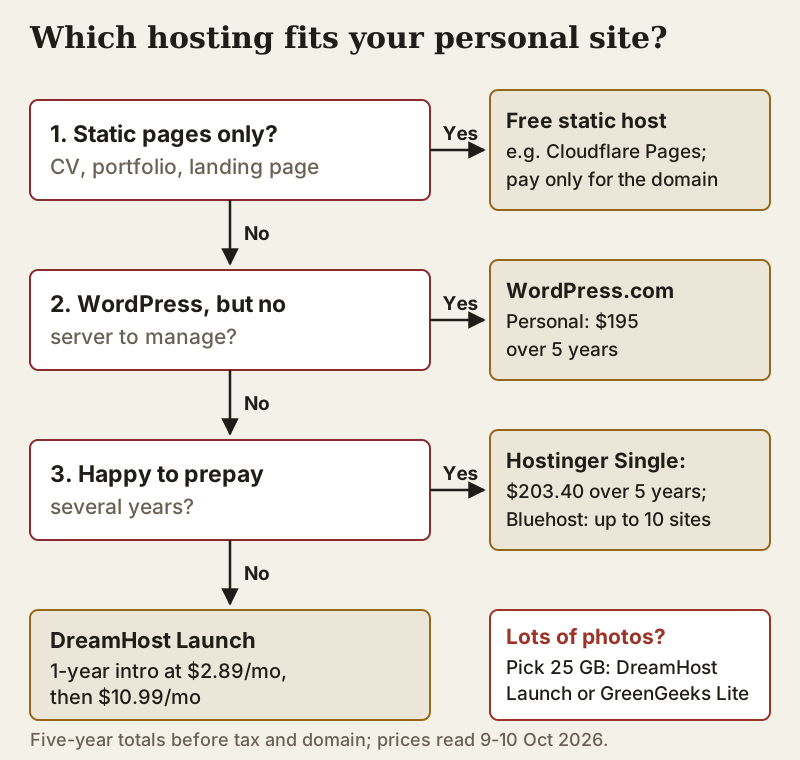
A résumé page, a link-in-bio page or a simple 'about me' site is a handful of HTML files. It needs no database and no PHP, so it doesn't need a shared hosting plan at all. A static host serves it free, with HTTPS, from a global network. Your only real cost is the domain.
A blog
A blog with comments, categories, an archive and a visual editor is where WordPress earns its place. You need PHP and a MySQL database, which every shared plan here includes, or a hosted WordPress.com plan that hides the server from you. Storage barely matters for text: 10 GB holds years of posts. What matters more is backups, because a blog's value is its archive, and that is where the best web hosting for blogging separates itself from the merely cheap. Hostinger Single and Bluehost Starter take weekly backups; DreamHost Launch and GreenGeeks Lite take daily ones.
A portfolio heavy on photos or video
Photographers and designers hit storage limits first. Hostinger Single and Bluehost Starter give 10 GB; Hostinger Premium 20 GB; DreamHost Launch and GreenGeeks Lite 25 GB of storage. Large originals belong in a separate image or video service, with the website holding web-sized copies. On a static host, note Cloudflare Pages' 25 MiB cap per file and 20,000 files per site on the free plan.
Picks for personal website hosting
These picks rank on the five-year arithmetic above and on what the entry plan includes. We haven't run speed or uptime tests, and nothing here is scored by commission.
Cheapest self-hosted WordPress over five years: Hostinger Single
Hostinger Single costs $95.52 for 48 months, $1.99 a month, and renews at $8.99, the lowest labelled renewal among the shared hosts here. It hosts one website on 10 GB of storage with weekly backups and one free mailbox. Two caveats: it's sold only on Hostinger's cheap-hosting page, not the main pricing page, and that page contradicts itself on whether a free domain is included, so check the cart before you pay. If you might add a second site, Premium covers three sites for $143.52 over 48 months, renewing at $10.99. See Hostinger's current plans.
Affiliate link, marked sponsored/nofollow. We may earn a commission at no cost to you — it never changes a score or a ranking.
Lowest effort for a blog: WordPress.com Personal
If you'd rather write than run a server, WordPress.com Personal is $99 for three years and renews at $3.50 a month on another 3-year term, or $5 a month yearly. It strips the WordPress.com ads that free sites show, bundles a domain at no charge for year one when you pay annually, and allows plugin installs and third-party theme uploads on every paid plan, Personal included. You give up server access and some control over performance tuning in return. WordPress.com isn't one of our partners; it's here because the numbers put it here.
Most sites on one entry plan: Bluehost Starter
Bluehost Starter allows 10 websites on 10 GB, with weekly backups, WordPress staging and a free CDN, for $3.99 a month if you commit to 36 months, and $9.99 once that term ends. That makes it the practical pick if you run several small personal projects. Phone support isn't included on Starter, and the intro price is only offered on the 3-year term. Check Bluehost Starter.
Affiliate link, marked sponsored/nofollow. We may earn a commission at no cost to you — it never changes a score or a ranking.
Shortest commitment: DreamHost Launch
DreamHost Launch is $2.89 a month for one year, then $10.99, with daily backups, 25 websites, 25 GB and a free domain for the first year with privacy included. The intro term is just 12 months, so you aren't prepaying for years you may not need, and DreamHost also offers monthly billing, though it doesn't print the monthly rate. Its terms promise 100% uptime with a credit if it slips. Over five years it costs more than the long-term options; you're paying for flexibility. See DreamHost Launch.
Affiliate link, marked sponsored/nofollow. We may earn a commission at no cost to you — it never changes a score or a ranking.
Daily backups on a single site: GreenGeeks Lite
GreenGeeks Lite hosts one website with 25 GB, daily backups, a free CDN and a free domain for the first year, at $2.95 a month for 12 months and $13.95 after. Its terms also include one free WordPress malware cleanup. It's a reasonable home for a single blog, but over five years only SiteGround costs more on this list. Check GreenGeeks Lite.
Affiliate link, marked sponsored/nofollow. We may earn a commission at no cost to you — it never changes a score or a ranking.
No lock-in at all: pay month to month
If you'd rather not prepay, the cheapest published monthly rates we found were Namecheap Stellar at $5.88 a month (three websites, 20 GB) and WordPress.com Personal at $9. Bluehost's knowledge base lists a monthly Starter renewal of $15.99. Five years of Stellar at the monthly rate is $352.80, more than Hostinger's prepaid route but with nothing locked in.
Do you even need paid hosting?
For a lot of personal sites, honestly, no. If you can live with a static site, built by hand or with a generator such as Hugo, Jekyll or Astro, a free static host is a better deal than any shared plan. The main options, with the limits that matter as of 9-10 Oct 2026:
| Host | Free allowance | The catch |
|---|---|---|
| Cloudflare Pages | Unlimited requests for static files; 500 builds a month; 100 custom domains per project | 20,000 files per site and 25 MiB per file on the free plan |
| Netlify Free | 300 credits monthly; each GB of bandwidth uses 20 credits, so about 15 GB if nothing else draws on them | Hard limit: the site shows 'Site not available' until credits reset |
| Vercel Hobby | 100 GB a month of fast data transfer | Non-commercial use only, so no ads, affiliate links or paid work |
Cloudflare Pages is the safest free choice for a portfolio or CV because static traffic isn't metered. Netlify's credit system works for a small site, but a traffic spike can take the site offline until the month resets. Vercel's Hobby plan forbids commercial use, so once your blog carries ads or affiliate links you'd need its $20-a-month Pro plan. What you give up on a static host is the WordPress dashboard, comments without a third-party service, and one-click plugins. If you write a few posts a year and are comfortable with Markdown, that trade is usually worth making.
The domain is the cost you can't avoid
Every option above needs a domain, and its renewal is a second cliff. A .com at Namecheap is $10.98 for the first year on sale, then $18.48 a year, so five years cost $84.90. Hosts that bundle a free first-year domain charge more to keep it: DreamHost renews a .com at $21.99, Hostinger at $19.99 and Bluehost at $23.99. Over five years, the free year saves you one registration but costs an extra $1.51 to $5.51 a year after that. Keeping the domain at a separate registrar also makes it easier to switch hosts later; our migration guide explains why.
Edge cases
Commercial use on a personal site. Once a personal blog runs ads, sells a course or carries affiliate links, Vercel's Hobby plan no longer qualifies, and you should check any free host's terms for similar clauses. Shared hosting plans don't distinguish personal from commercial use.
Email at your own domain. Hostinger Single includes one mailbox; DreamHost gives 20 mailboxes free for three months only. Static hosts include none, though Cloudflare's Email Routing can pass mail sent to your domain on to an existing inbox. It receives and forwards; it doesn't send.
Traffic spikes. A post that goes viral is a bigger risk on Netlify's free credits than on a shared plan. DreamHost treats Launch's 40,000 monthly visits as guidance rather than a hard cap, and Cloudflare Pages doesn't meter static requests at all.
Moving later. A static site moves between hosts in minutes. WordPress takes longer, but Hostinger, Bluehost, DreamHost, GreenGeeks and SiteGround all offer a free migration tool or service, so starting cheap and moving at renewal time is a sensible plan, provided the domain isn't tied to the host.
Sources (read 9-10 Oct 2026): pricing pages from Hostinger, WordPress.com, Namecheap, Bluehost, DreamHost, GreenGeeks and SiteGround; Cloudflare Pages limits, Netlify's credit documentation and Vercel's fair-use guidelines. Prices exclude tax.
Personal website hosting: common questions
Which hosting is best for a personal website?
Can I host a personal website for free?
What does personal blog hosting cost over five years?
Is WordPress.com or self-hosted WordPress better for a personal blog?
Do I need a separate domain for a personal website?
See how this fits the field: the best web hosting, ranked, or the side-by-side hosting comparison.