Web Hosting Statistics 2026: Market Share, Renewals and Uptime
The biggest web host in 2026 is not a classic hosting company. W3Techs' survey, read on 9 Oct 2026, puts Shopify first at 5.4% of all websites, ahead of Hostinger at 5.1% and Amazon at 4.5%, with Wix at 4.2%. No provider hosts more than about one site in twenty, and the median entry shared plan we tracked renews at 3.8 times its introductory price.
Most hosting statistics pages recycle each other's numbers, often undated and second-hand, and almost none connect who hosts the web with what hosting costs after year one. This page uses primary sources only, each with its read date: W3Techs for market share and CMS usage, the hosts' own pricing pages for intro and renewal prices, and the hosts' own terms of service for uptime promises. Where a figure could not be confirmed on a primary page, it is left out.
Who hosts the web in 2026: market share by provider
W3Techs measures which hosting provider serves each site in its sample and publishes the share of all websites per provider. Its figures update daily, so treat these as a snapshot from 9 Oct 2026.
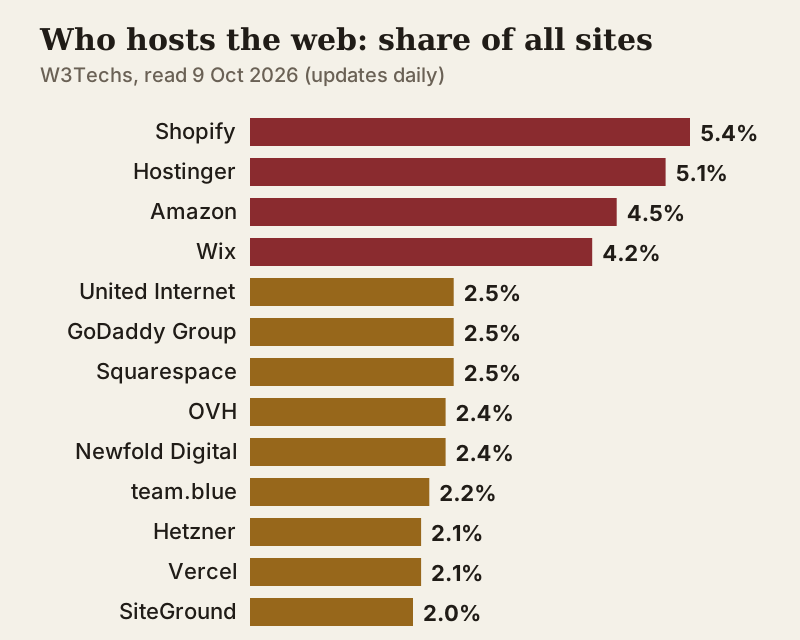
Three things stand out. First, the top of the list is split between very different businesses: a store builder (Shopify), a budget shared host (Hostinger), a cloud platform (Amazon), and two site builders (Wix and Squarespace). Second, the market is fragmented. Shopify's 5.4% is the largest single share, and the next twenty providers each hold between 0.3% and 5.1%. Third, the developer clouds are now hosting providers in their own right: Vercel holds 2.1% and DigitalOcean 1.5%, alongside Hetzner at 2.1% and Google at 1.7%.
Further down, the familiar names are smaller than their advertising suggests. SiteGround serves 2.0% of all websites, WP Engine 1.3%, Namecheap 0.6%, Kinsta and DreamHost 0.3% each, and InMotion 0.2%. Market share measures where sites sit, not how well they are served, but it is a useful corrective to "the world's leading host" claims.
The hosting groups behind the brands
Many hosting brands share an owner, and W3Techs groups some of them together. These ownership links are confirmed on the companies' own pages:
- Newfold Digital owns Bluehost and HostGator, alongside Yoast and YITH, according to its brands page. W3Techs counts the Newfold Digital group at 2.4% of all websites.
- WP Engine acquired Flywheel in 2019; W3Techs' WP Engine group holds 1.3%.
- Cloudways has belonged to DigitalOcean since September 2022, a $350 million deal per DigitalOcean's investor news.
- Pressable describes itself as an Automattic hosting lab, and W3Techs counts the Automattic group at 0.8%.
- Liquid Web is a sub-brand of Nexcess Corp. and runs on the Nexcess platform.
- Hosting.com is the merged brand of World Host Group and A2 Hosting, placed under its 2025 heading on its own timeline; a2hosting.com now redirects there.
Why this matters to a buyer: switching between two brands of the same group may not change the infrastructure, support systems or pricing model as much as the logos suggest. When you compare hosts, compare their terms, not their branding.
The renewal multiple: intro vs renewal across top shared hosts
Advertised hosting prices are first-term prices. The renewal multiple, the renewal rate divided by the intro rate, shows how much a plan's price rises once that term ends. We read the intro and renewal price of each plan on the host's own US pricing page.
| Plan | Intro price and term | Renewal | Multiple |
|---|---|---|---|
| Hostinger Single | $1.99/mo, 48 months | $8.99/mo | 4.5x |
| Hostinger Premium | $2.99/mo, 48 months | $10.99/mo | 3.7x |
| Hostinger Unlimited | $3.99/mo, 48 months | $16.99/mo | 4.3x |
| DreamHost Launch | $2.89/mo, 1 year | $10.99/mo | 3.8x |
| DreamHost Growth | $3.99/mo, 1 year | $12.99/mo | 3.3x |
| GreenGeeks Lite | $2.95/mo, 12 months | $13.95/mo | 4.7x |
| GreenGeeks Pro | $4.95/mo, 12 months | $18.95/mo | 3.8x |
| SiteGround StartUp | $2.99/mo, 12 months | $17.99/mo | 6.0x |
| Bluehost Starter | $3.99/mo, 36 months | $9.99/mo | 2.5x |
| HostGator Hatchling | $3.75/mo, 36 months | $10.99/mo | 2.9x |
| IONOS Essential | $4/mo, 1 year | $8/mo | 2.0x |
| IONOS Plus | $1/mo, 1 year | $14/mo | 14.0x |
| DigitalOcean Droplet 1 GiB | $6/mo, no term | $6/mo | 1.0x |
| Kinsta Single 35k | $30/mo billed annually ($35 monthly), no intro rate | Same rate | 1.0x |
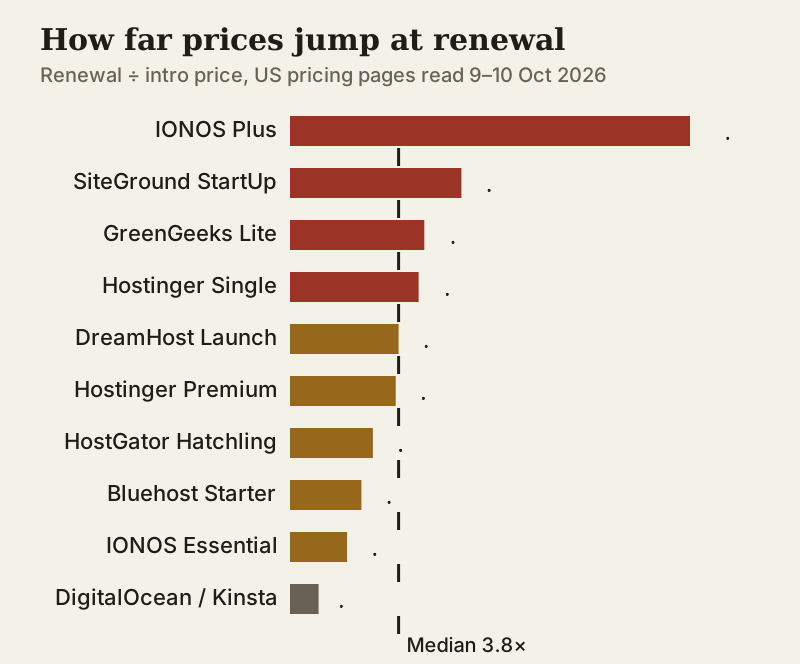
Across the nine shared entry plans in the chart, the median renewal multiple is 3.8, meaning the typical cheap plan costs almost four times as much per month from its second term. The spread is wide. IONOS Essential renews at twice its intro price, while IONOS Plus, the $1 offer, renews at fourteen times. SiteGround's StartUp renews at six times the intro price shown on its WooCommerce page, at $17.99 a month. Bluehost Starter (2.5x) and HostGator Hatchling (2.9x) sit near the low end, but only on their 36-month terms; Bluehost's own help page lists the Starter renewal at $11.99 on a 12-month term and $15.99 on monthly billing.
Hosts that do not discount the first term sit at a multiple of one. DigitalOcean charges the same monthly price from the first day, and Kinsta publishes no intro rate, only a cheaper annual option. These are more expensive per month in year one and far more predictable over five years.
Our best web hosting rankings score each host on the price you renew at for this reason. If you want a modest renewal on a one-year commitment, DreamHost's Launch plan renews at $10.99 with 25 websites included; if you can prepay four years, Hostinger is the cheapest of these to own.
How many sites run WordPress, and why it shapes hosting
WordPress powers 40.1% of all websites, according to W3Techs on 9 Oct 2026, which is 58.6% of sites that use a content management system it can detect. Shopify follows at 5.4% of all websites, Wix at 4.2%, Squarespace at 2.4% and Joomla at 1.1%. About 31.6% of sites use no CMS that W3Techs tracks, which includes hand-built sites, static site generators and custom applications.
That single statistic explains much of the hosting market's shape. Because two in five sites run the same PHP application, hosts compete on WordPress features: one-click installs, managed updates, staging copies and WordPress-specific caching. It also explains why "WordPress hosting" is often the same plan as ordinary shared hosting with a different name; GreenGeeks, for instance, sells its WordPress plans with the same specs as its shared ones.
The rest of the top ten tells the opposite story. Shopify, Wix and Squarespace bundle hosting with the site builder, so their customers never choose a host at all. Together those three account for 12% of all websites by W3Techs' count.
Uptime SLAs: what hosts actually promise in their terms
Most hosts advertise an uptime percentage. Fewer put a remedy in their terms, and the remedy is almost always a credit, not a refund. We read the terms of service for each host below.
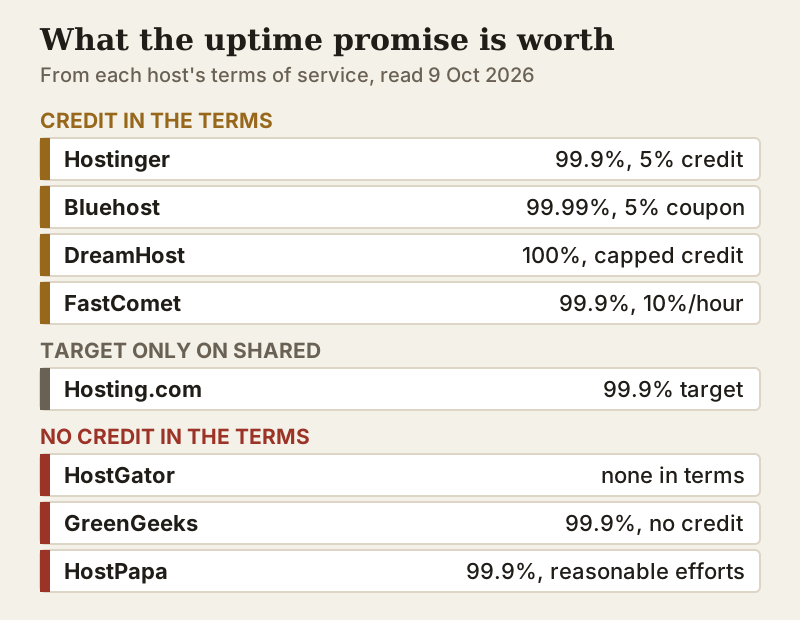
Whether a promise carries a remedy tells you more than how many nines it quotes. Hostinger promises 99.9% and credits 5% of the monthly fee, usable only for further purchases, if you claim within 30 days. Bluehost commits to 99.99% for shared accounts, with the remedy capped at one 5% coupon per month. DreamHost promises 100% and credits one day of service per hour of interruption, capped at 10% of the next renewal and counted from when you open a support ticket. FastComet credits 10% of the monthly fee per hour of network downtime.
At the other end, HostGator's terms contain no uptime guarantee or credit, even though its web hosting page carries a "99% uptime guarantee" heading. GreenGeeks promises 99.9% with no credit mechanism described, and HostPapa commits to "reasonable efforts" toward 99.9%. Hosting.com's maintenance policy describes 99.9% as a target with a 5% credit per full hour, while its plan comparison lists the SLA as not included on shared plans.
For scale: an average month at 99.9% still leaves room for roughly 44 minutes offline, and 99.99% for about 4 minutes. Our guide to what uptime guarantees mean works through the claim process.
Pricing changes worth knowing in 2025 and 2026
Hosting prices and free tiers have shifted several times recently, which is why undated statistics go stale fast:
- Hetzner raised cloud prices on 1 April and 15 June 2026; its CX23 server now costs €5.49 a month, up from €3.99.
- DigitalOcean Droplets have been billed by the second since the start of 2026, subject to a one-minute minimum charge.
- Netlify put every account created from 4 September 2025 on credit-based plans; on the free plan, sites are paused with a "Site not available" page once the credits run out.
- AWS changed its free tier for new accounts on 15 July 2025: the new free plan ends after six months or when its credits run out, while older accounts keep the legacy 12-month trials.
- Median home-page weight reached 2.86 MB on desktop and 2.56 MB on mobile in the HTTP Archive's 2025 Web Almanac, a mobile rise of 8.4% in a year, so each visit asks more of the server than it used to.
What we did not include
Market-size estimates for the hosting industry vary widely between research firms and are not primary data, so we do not quote one. We also do not publish uptime or speed measurements of our own, because we have not run a monitored test that would support them. SiteGround's and InMotion's uptime credit terms could not be confirmed on a primary page, and Hosting.com's current shared prices could not be read for this update, so it is absent from the price table.
Methodology and sources
- Market share and CMS usage: W3Techs' web hosting provider and content management system usage statistics, read 9 Oct 2026. W3Techs reports shares of all websites in its sample and updates daily.
- Prices: each host's US pricing page, read over a US connection on 9 and 10 Oct 2026. Renewal multiples are our arithmetic (renewal divided by intro).
- Uptime terms: each host's terms of service or SLA page, read 9 Oct 2026.
- Ownership: Newfold Digital's brands page, DigitalOcean's investor news, WP Engine, Pressable and Hosting.com's about pages.
- Downtime minutes: our arithmetic on an average month of 30.4 days.
You may quote or chart any figure on this page with a link back; please keep the read date with the number. For the plans side by side, see our web hosting comparison.
Web hosting statistics: quick answers
What is the market share of web hosting providers?
Who is the largest web hosting company?
What percentage of websites use WordPress?
How much do web hosts raise prices on renewal?
What uptime do web hosts guarantee?
See how this fits the field: the best web hosting, ranked, or the side-by-side hosting comparison.